Why should I automate my End of Line?
February 4, 2022
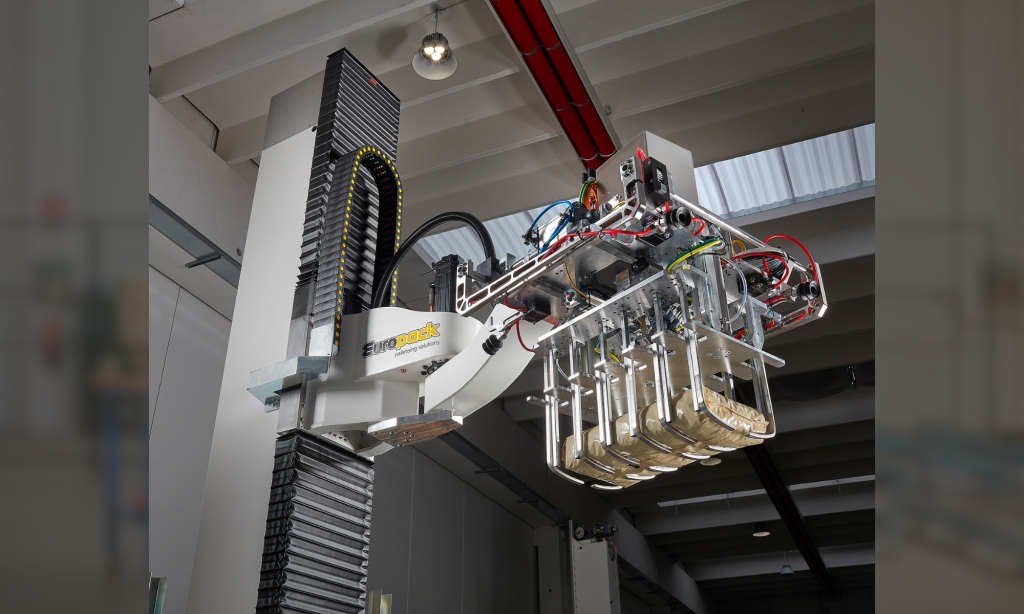
Palletizing fertilizer bags
February 4, 2022
What Is a Palletizer?
Definition, operation and benefits of automated palletizing
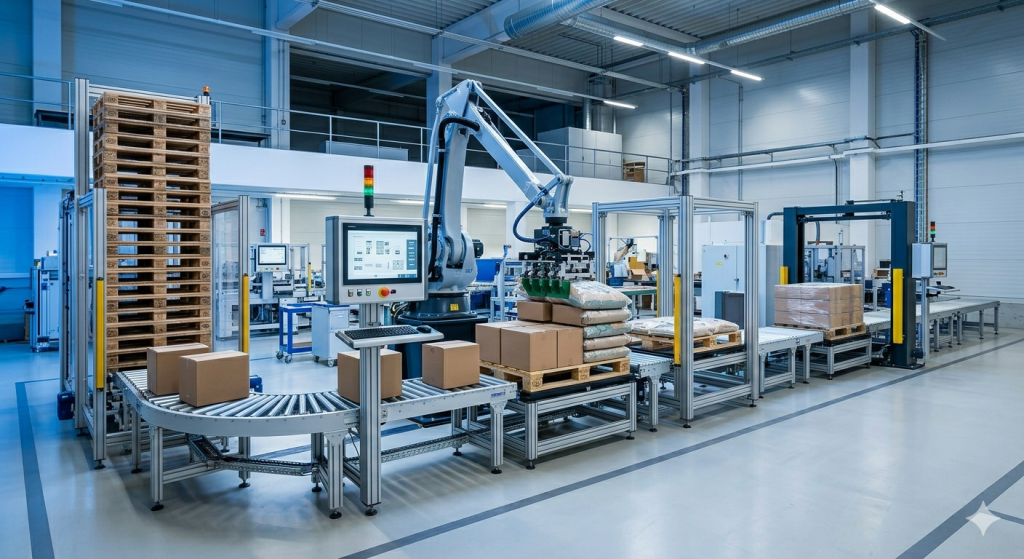
A palletizer is an automated machine designed to stack packaged products onto pallets in an orderly, precise and repeatable way.
The palletizing process is a critical stage in industrial production lines, as it prepares products for storage and shipment efficiently and safely.
Automating this phase reduces manual handling, increases productivity and ensures consistent pallet quality.
What Is Palletizing?
Palletizing is the process of arranging products such as bags, boxes, bundles or packs onto a pallet according to a predefined pattern, ensuring stability and easy handling.
Traditionally performed manually, palletizing is now increasingly automated to address:
high production volumes
heavy and repetitive loads
continuous production requirements
stricter safety standards
How Does a Palletizer Work?
An automated palletizer operates as part of the production line, following a controlled and repeatable sequence.
In general, the process includes:
Products arrive from the conveyor or packaging machine
Items are oriented and aligned correctly
Layers are formed or products are picked individually
Products are placed onto the pallet according to the selected layout
The completed pallet is transferred to the next stage (wrapping, storage or shipping)
All operations are managed by control systems that guarantee precision and repeatability.
Types of Palletizers
Conventional (Layer) Palletizers
Conventional palletizers work by forming complete layers of products and placing them onto the pallet.
Main features:
high production speeds
ideal for uniform products
suitable for continuous and standardized production
They are particularly effective when product formats remain consistent over time.
Robotic Palletizers
Robotic palletizers use industrial robots equipped with grippers or vacuum tools to handle products.
Key advantages:
maximum flexibility
ability to handle multiple formats and pallet patterns
fast changeovers
compact layouts
For these reasons, robotic palletizers are increasingly used in modern production environments.
What Products Can Be Palletized?
A palletizer can handle a wide range of products, including:
The correct configuration depends on several factors such as product weight, stability, required speed and plant layout.
Benefits of Automated Palletizing
Automating the palletizing process offers several advantages:
Increased production efficiency
Reduced labor costs
Improved operator safety
Consistent pallet quality and stability
Lower risk of manual handling errors
Over time, a palletizer contributes to improving the overall competitiveness of the production line.
When Should You Install a Palletizer?
Installing a palletizer is recommended when:
manual palletizing becomes a production bottleneck
products are heavy or repetitive to handle
continuous operation is required
the number of formats or SKUs increases
safety and ergonomics need improvement
In these cases, palletizing automation represents a strategic investment.
Europack Palletizing Solutions
Europack designs and supplies custom palletizing solutions, developed around each customer’s specific production needs.
Every system is engineered based on:
product characteristics
required line speed
available space
future scalability
From robotic palletizers to complete palletizing lines, Europack supports customers throughout the entire project lifecycle—from design to installation and after-sales service.
Do you want to verify the benefits of integrating an automated palletizing system within your production cycle? Contact us and let's evaluate them together!