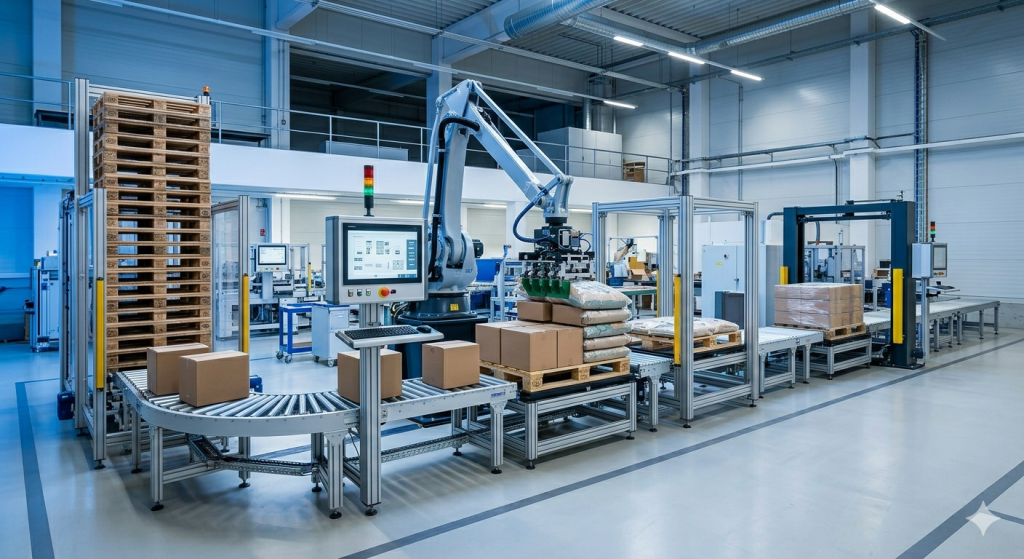
Palletizing of Pet Food Boxes
August 2, 2022
Palletizing of valve and open-mouth bags
November 7, 2022KERS: the energy recovery system that makes the WINNER REVO palletizing robot more efficient
What is KERS and why is it important in palletizing lines?
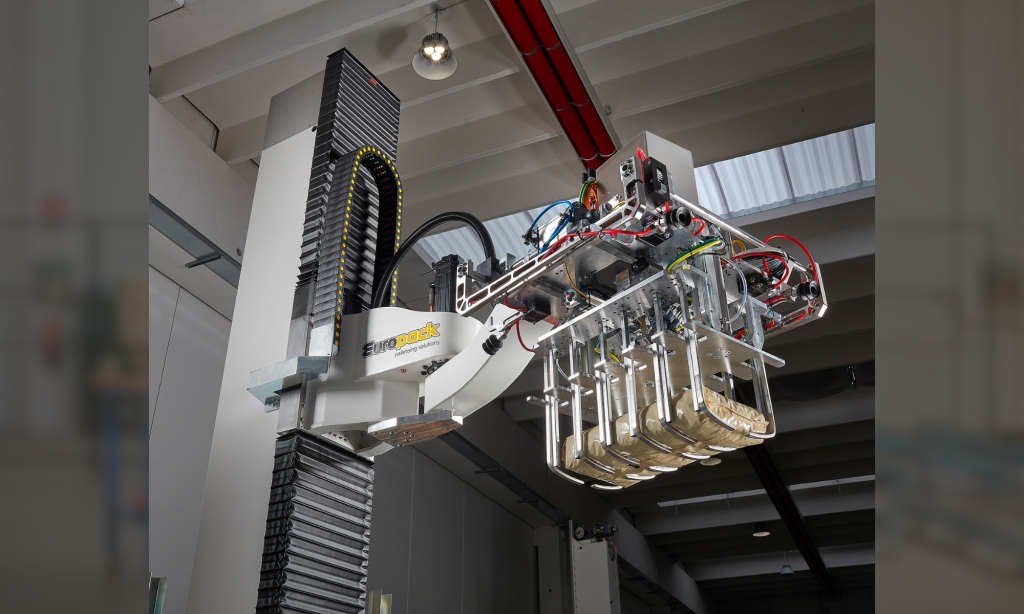
KERS (Kinetic Energy Recovery System) recovers the kinetic energy generated during braking and converts it into reusable electrical energy. In our WINNER REVO palletizing robots, the four servomotors are interconnected: the energy produced during deceleration is redistributed to the axes during acceleration, reducing the peaks absorbed by the network and improving the overall efficiency of the palletizing line. The result: lower consumption, less heat dispersion, and greater work continuity.
Measurable benefits: up to 70% energy savings per cycle
A comparative study of three stations (WINNER 500 GREEN, WINNER 500 ER, articulated robot) showed that a system with brushless motors + KERS consumes ~0.375 kWh compared to ~1.27 kWh for a standard robot, equal to ~70% savings per palletizing cycle. With typical use (8 hours/day, 300 days/year) and an average cost of €0.501/kWh, the estimated annual savings are ~€1,000 per station.
From theory to field data
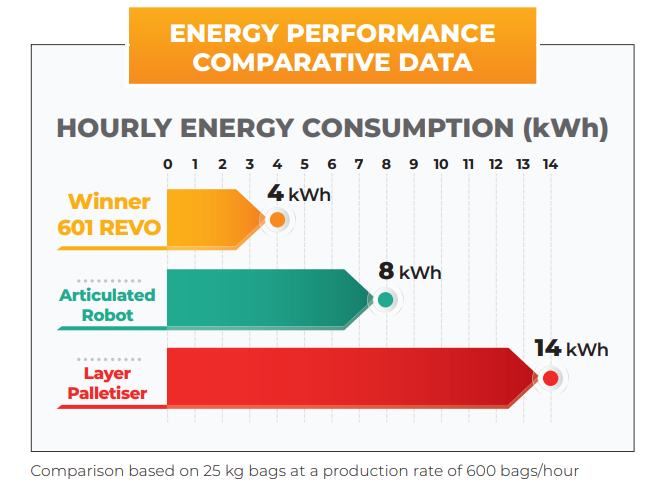
Recent field data collected on different types of palletizers shows that in the production of 25 kg bags at up to 600 pcs/hour, the indicative hourly consumption is:
- WINNER 601 REVO: ~4 kWh
- Articulated robot: ~8 kWh
- Layer palletizer: ~14 kWh
These data confirm that the KERS system significantly reduces the energy required for each pallet.
Efficiency that becomes productivity
The WINNER REVO series also adopts new drives and controls for smoother and more precise movements, further benefiting the line's consumption and production capacity. Energy efficiency is not just about sustainability: it translates into lower TCO, lower operating costs, and faster ROI on plants with extended shifts or multi-format operations.
Where KERS makes the difference
- High volumes and fast cycles: more decelerations → more energy recovered.
- Multi-axis work: energy exchange between axes during acceleration/braking.
- ESG strategies: measurability of energy savings and CO₂
Frequently asked questions (FAQ)
- What exactly is the KERS system on a palletizing robot?
- It is a kinetic energy recovery system that generates electricity during braking instead of dissipating it as heat. This energy powers the robot's other axes/utilities.
- How much can I save in my application?
- In typical scenarios, consumption per cycle can be reduced by up to ~70% compared to a standard robot. Annual savings depend on shifts, kWh rates, and load profile; in a reference use case, they are ~€1,000/year per cell.
- Does KERS affect palletizing speed or quality?
- No: REVO drives and kinematics maintain (and often improve) fluidity and productivity, with reduced electrical peaks and cycle stability.
- For which products is it recommended?
- Bags, boxes, bundles, reels, crates: in general, wherever there are repetitive movements with frequent acceleration/braking, from which KERS derives maximum benefit.
Want to know more about Europack palletisers and the KERS system? Contact us!